Showing posts with label Keywords. Show all posts

Wednesday, January 7, 2015

SEMRush: A Must-Have Tool for Keywords and SEO

It isn’t too often that an online marketing tool comes along that truly stands out. Hundreds of tools are launched every year with the aim to help digital marketers achieve optimal results for their online efforts. While some of these new tools have their fair share of neat bells and whistles, few compare to the cutting edge features of SEMRush. As one of the ultimate keyword research tools available on the market, SEMRush also provides valuable data in terms of SEO.

If you are looking for a no-nonsense research tool that delivers, SEMRush is a must-have for your marketing toolkit.

SEMRush Streamlined Dashboard Makes Searching a Snap

SEMRush’s beautifully designed dashboard displays everything that you need in a way that makes perfect sense. Keyword and SEO tools can tend to be a bit cluttered, with organization features falling short. SEMRush has the organization element down pat, with a sidebar full of options on the left, neatly displayed custom stats in the center, and a convenient search bar right at the top.
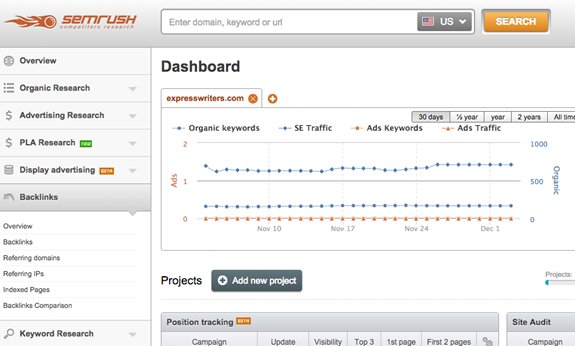

Another benefit of SEMRush’s design is that you don’t have to dig much to get information. One thing that I dislike about Google Analytics is that there are way too many sections that you have to dig through, and Google is a big fan of moving things around in the dashboard on a regular basis. Analytics is a bit too cluttered and congested for my taste, but SEMRush does an excellent job of displaying categories without going into information overload. For the most part, you get the information you are looking for within 1-3 clicks; just the way I like it.

In-depth Keyword Research For Marketers

Want to know, well, everything, about a particular keyword? SEMRush has an in-depth keyword tracking system that gives you valuable keyword data that is refreshed on a regular basis. Once you search for a specific keyword, the dashboard fills with SEO-related data from cost per click to the number of search results.


The keyword summary is a snapshot that tells you how much competition you are facing with that keyword, and how many people are searching for that term to date. The cost per click is helpful for those researching for an Google Adwords campaign, because it gives real time data with how much that keyword is costing at the moment.

SEMRush Knows What’s Trending

Another advantage of SEMRush is that it displays the search trends for a specific keyword during the year. Christmas lights is a seasonal keyword, and you can clearly see the trend spike in the graph.
The live update feature also gives you a glimpse if a keyword is currently trending, which you can judge by search volume and the number of search results.

Keyword Opportunities: Exact Match And Related

There is no shortage of keyword data on SEMRush with both its exact match and related keyword categories.


The phrase match report outlines any keyword containing the exact phrase of Christmas lights. SEMRush displays the top 10 most popular extract phrases for the moment, with the option to view the entire report or export it into an Excel spreadsheet.

The related keywords report outlines terms that are similar to your keyword, but not an exact match. You can find some interesting keyword opportunities in the related report, and I always default to it when I am looking for new terms. The related keywords can range anywhere from competitor names and websites, to more specific terms relating to color or style. In any case, you can usually find some good opportunities when you dig a little bit in the related keywords report.

SEMRush Will Crush Competitor Search Data

In terms of keyword data, you can find nearly everything that you need to know about your competitor on SEMRush. For example, if I am an online retailer that sells Christmas decorations, a competitor of mine might be christmascentral.com. I type their web address into the search bar, and the results load in the dashboard.


You can see here that their top keywords are mostly their brand name, but you also have the product keyword of fiber optic Christmas tree. According to SEMRush, this website has over 7,000 keywords. You can view the entire report on the dashboard, or export it into an Excel spreadsheet as well.

The traffic feature is a tool where you can see what percentage of traffic a particular keyword brings to a website. Judging by the data, the Christmas Central brand name brings approximately 10 percent of the company’s traffic.


Two other useful features for analyzing competitor data is the organic and paid traffic pattern graph, and the backlink data. In this instance, you can see that Christmas Central ran a pay-per-click campaign over the course of January 2013-2014. Judging by the organic vs. paid traffic patterns, it did not look like the paid campaign was too successful. There is no way to know a conversion rate, but the traffic pattern speaks volumes. It also looks like their PPC campaign was discontinued for the following season.

The backlink feature is new to SEMRush, and as usual, the platform does not fall short on providing valuable information.


Running a backlink report on Christmas central, SEMRush displays over 6,000 sources linking to the website. You can see all the backlink details here, from anchor text and external links, to the exact source URL. There is a lot of great data when you want a close look behind the scenes at your competitors’ backlink overview.

SEMRush Puts Competitor Research Tools to The Test

While there are compelling advantages of SEMRush featured here, there are many other components of the platform to be explored. From organic research, new and lost keywords, position tracking and more, there is undeniably loads of invaluable information to gain from SEMRush. If you are looking for a few new investments for your 2015 marketing goals, SEMRush is an excellent addition to every marketer’s toolkit.


15% Off All Business Cards


VIEW ALL CARDS


$60.05


$60.05


$60.05


$62.55


$60.05


$60.05


$60.05


$60.05


$52.55


$52.55


$60.05


$60.05


Saturday, December 13, 2014

Keyword Domains: Still SEO Gold?


Photo Credit: Domain Name Extensions by Tristan licensed under CC BY 2.0
 

SEO is a dynamic world, and trends dissipate on an almost daily basis. Keywords themselves are a perfect example; in many ways, they’ve been under attack recently, no longer as powerful as they once were. So does that mean domains that feature keywords are falling out of favor
as well?

An SEO software company called ‘CanIRank’ says absolutely not. While many mainstream SEO experts are touting that the power of these expensive commodities has dwindled, new research from CanIRank disputes these claims in a major way. In fact, they state that even if Google has been scaling back on giving a boost to keyword domains, their power hasn’t lessened.

Why? Because according to their research, the inherent power of a keyword-centric domain doesn’t even need Google for validation; these quite often hold their own no matter what Google’s algorithm prefers. According to the study, “people are more likely to use relevant keywords as anchor text when they link to a keyword domain, which holds a lot of weight.”

If you’re a startup pondering the conundrum of a domain purchase, the CanIRank study unequivocally says a keyword URL is integral. They state that the average keyword domain purchase is just $2,000, which “can be calculated against link building and traditional SEO efforts to determine which combination of tactics will provide the best ROI.”

What Makes the CanIRank Study Uniquely Powerful

So how does a new startup’s study stack up against the opinions of many other SEO experts? For one, they have math on their side.

CanIRank approached this research in a different manner than most other similar studies. As a rule, previous studies would only examine the impact of a single ranking factor, looking at the correlation between high and low rankings against this one consideration. And quite often, this involves the almighty backlink.

But as anyone who has attempted SEO knows, search engine algorithms are far more complex. But in CanIRank’s words, what’s most important is “a series of intertwining classifiers trying to determine e.g., what type of site we’re dealing with, how quality the page is, and how authoritative the site is in that topic area, and whether or not the page is spam. Each individual factor is simply another piece to the puzzle. An apt metaphor is a blind man trying to identify an elephant: How large is it? Does it have a tail? Does it have a trunk?” Instead of single correlations, CanIRank looked at the relative impact of multiple ranking factors, creating a more “nuanced” story, with results that feel a lot more compelling and trustworthy.

The Stats That Indicate Keyword Domains are Still Must-Haves

In CanIRank’s comprehensive study, the following key findings were crucial in their analysis of how important keyword domains still are. For starters, they found that keyword domains still rank, on average, 11% higher than brandable domains. In addition, these points were highlighted:
  • Brandable domains needed an average of 40,000 more links to hit #1, and 35,000 more links to reach the Top 10
  • Brandable domains needed 69% higher Domain Authority and 22% higher Page Authority to rank in the Top 10
  • Keyword domains were able to hit #1 with half as much content, and only using the keyword half as frequently
  • Looking at all Ranking Factors, it’s clear that keyword domains rank more easily due to higher Website Relevancy and Website Ext Relevancy scores

This study emphasizes that when you look at rankings based on a single correlation, keyword domains don’t necessarily hold much weight anymore. Yet this simplistic view is vastly misleading. CanIRank outlines the importance of keyword domains this way:

“Websites built on keyword domains naturally attract more keyword-relevant anchor text, one of the oldest but still most influential ranking factors, and something that happens only rarely for brand sites. In addition, websites built on keyword domains tend by their nature to be highly focused on the keyword topic, and at least some of this relevancy may be attributable to the domain name. In many ways, small, focused keyword websites are a crucial part of Google search result pages that seem to always feature the same half dozen big brands. They provide necessary domain diversity, and it’s hard to argue that an entire website focused on a topic doesn’t provide better information than a single page of content written by a non-specialist on say, CNN or the New York Times.”


Is a Keyword Domain Right for Your Business?


Even with this powerful data, keyword domains aren’t necessarily a must for every company. They are, after all, one tool in a marketing strategy’s toolkit, and balance is the secret to success. If you score high on the following attributes, a keyword domain may not move the needle much more:
  • PR
  • Affiliate programs
  • Brand awareness and expansion
  • Social media

In other words, how much heavy lifting do you expect your keyword domain to take on? If you’re already adept at various other means of marketing and SEO, you can afford to get a brandable or more esoteric URL. If you aren’t strong in the methods listed above, however, a keyword domain still has the power to boost your rankings. It all depends on the cost of the domain you have in mind, and how much power it will lend to your overall marketing strategy.

30% Off All Business Cards

Custom Business Cards

All cards ship tomorrow + Free Shipping!

Iridescent Pearl Finish Business Card (Style 3)Iridescent Pearl Finish Business Card Template
White Linen Business CardsPhoto Business Cards (Platinum Finish)
French Linen Business Card Template (Sky)) Metallic Finish Business Cards (Style 2)
Gold Finish Business Card