Showing posts with label scheduling. Show all posts

Monday, March 16, 2026

One scheduling change sharply reduced after-hours EHR work in physician practices

A new study in JAMA Network Open takes a close look at a simple but increasingly popular idea in physician practices: setting aside protected time during the workday for electronic health record (EHR) tasks.

Instead of pushing inbox work into nights and weekends, one ambulatory network reserved a dedicated appointment slot each half day for activities such as patient messaging, prescription refills and prior authorizations. Researchers tracked what happened to productivity, after-hours work and message volume over nearly three years.

Think it's time to make a change? Get access to Software Advice's EMR Software Pricing Guide

The results suggest that small scheduling changes can have an outsized impact on physician workload. After-hours and weekend EHR time dropped quickly after protected time was introduced, while productivity took only a modest short-term dip and then stabilized.

A new study suggests that carving out protected time for electronic health record (EHR) work can sharply reduce after-hours charting and weekend inbox labor — with only a modest, short-term impact on physician productivity.

The findings come from a study published in JAMA Network Open on Dec. 2, 2025, that examined what happened after a large ambulatory network in the western United States began reserving one appointment slot per half-day for physicians to complete asynchronous EHR work.

The protected slots were used at physicians’ discretion for tasks such as patient messaging, prior authorizations and prescription refills.


Productivity dipped, then stabilized


Researchers analyzed data from 130 general internal medicine physicians working between November 2021 and June 2024. Eighty-nine physicians practiced in a control network, while 41 participated in the protected-time intervention.

After the new scheduling model launched in November 2022, the intervention group saw an immediate decline of about 13 relative value units (RVUs) per week compared with the control group. Over time, however, RVUs began trending upward again, suggesting the early productivity effect did not worsen.

The control group’s productivity remained largely stable throughout the study period.


Nights and weekends improved quickly


Time-stamped EHR log data showed immediate improvements in work-life boundary erosion:
  • After-hours EHR use dropped by nearly 25 minutes per week.
  • Non-workday EHR use dropped by nearly 29 minutes per week.

Those reductions persisted through the remainder of the study period.

Patient message volume rose briefly after the intervention began but then declined over time.


Burnout fell sharply at the intervention site


Although burnout was not measured across both networks, a pre- and post-intervention survey conducted at the protected-time practice found that physician burnout fell by 81% after implementation, according to the authors.

The study relied on observational methods and included differences in physician full-time equivalency and practice structure between sites, which may limit how broadly the findings apply.

The authors concluded that reserving dedicated time for asynchronous EHR work may reduce administrative burden without fundamentally undermining revenue — at least in fee-for-service, ambulatory settings similar to those studied.

For practice leaders, the study adds weight to a growing argument that EHR burden is not only a software issue, but also a scheduling and staffing issue. How inbox work is structured inside the clinic may matter just as much as which platform the practice runs.

Not all EHR systems support asynchronous workflows equally — and that gap becomes more visible as practices rethink inbox labor.

Medical Office Supplies


Medical and Rx Pads


 Billing and Collection Supplies


Business Cards and Stationary


Chart Labels


Monday, March 9, 2026

Improving productivity by reducing capacity in your schedule

It's been than several years since COVID-19 and the March 2020 lockdown. Today, many of our schedules are full, with patients waiting 3-4 weeks for an appointment, yet our revenues are flat or even decreasing. This is a situation all too familiar to many physicians and their practices. (If you are compensated by the number of RVUs, note that the Medicare conversion factor for 2025 decreased by 2.83% to $32.3465, down from $33.2875 in 2024) With declining reimbursements, what do we do?

There are two solutions to this dilemma: 1) increase capacity, which entails increasing the staff, adding more providers, increasing space, increasing overhead expenses, and creating a trajectory to burnout, or 2) reducing a select volume of patients. As volume reaches capacity, doctors must be prepared to give up the bottom 15% of patients to increase revenue. By eliminating the bottom 15%, there will be increased capacity for patients, allowing physicians to focus on areas where they are exceptionally skilled and/or have the greatest interest or expertise. The bottom 15% of revenue is frequently generated by a disproportionately high number of patients, for whom reimbursements are inadequate for the care provided. Now, an additional capacity will be freed up for revenue growth when the bottom 15% of patients who create more work with less productivity are eliminated. Opportunities to reduce the costs associated with this excess capacity can also be identified.

Two situations in which reducing the bottom 15% should be considered: 1) the bottom 15% of a practice's revenue is likely to be generated by the lowest paying payer, and 2) the bottom 15% of revenue may be generated by specific diagnoses or services that are not appropriately compensated or productive.

Usually, the bottom 15% of revenue is often generated by a disproportionately high number of patients. As a result, a greater capacity in the schedule will be freed up for treating patients which has the greatest interest, require the greatest skill and enjoyment, and receive the most favorable reimbursements. When excess capacity removes the bottom 15%, there is usually an associated reduction in overhead costs.

The four situations where elimination of the bottom 15% is appropriate occurs: 1) when the schedule has reached full capacity, 2) when patients must wait 3-4 weeks to access the practice, 3) when you have identified the lowest payers or those payers who take weeks or months to pay for your services, and 4) when your revenue is flat or declining.

Before reducing the bottom 15% of patients, it is important to consider the impact of removing the bottom 15%. You should consider what effect this will have on your referral sources. One option is to refer those patients to another doctor in the practice who does not have a full schedule, such as a new associate who has recently joined the practice.

The benefit of reducing the bottom 15% is greater physician satisfaction in treating those conditions, allowing them to focus on procedures they prefer. Now the physician has more time to manage the chief complaint, but also discuss secondary issues that have been "put off to later". This can occur when the doctor rushes to see all the patients on the schedule. This results in less time spent with each patient, which decreases patient satisfaction, reduces the likelihood that desired medical outcomes are achieved, and may increase the risk of litigation. By removing the bottom 15%, you are likely to experience increased revenue from additional procedures and tests, greater patient satisfaction, improved online reputation, and better outcomes.

The bottom line: By eliminating the bottom 15% of work, the physician has more time to focus on the things that they prefer treating. This is a win-win for doctors and patients, with increased patient satisfaction and revenue.


Medical Office Supplies


Medical and Rx Pads


 Billing and Collection Supplies


Business Cards and Stationary


Chart Labels


Wednesday, January 3, 2024

Fill your schedule: Using recall lists to increase production

Unfortunately, the last few years have seen an erosion of urologist’s incomes-reimbursements decreasing and overhead increasing. We cannot significantly impact reimbursements. However, we can fill our schedules not only with new patients, but also increasing existing patients returning to our practices.

The most valuable patient in your practice is your existing patient. These are the patients who already have a relationship with you and have confidence in your knowledge and skills. These are the patients who recommend you to their friends and family, they leave positive online reviews, and readily come to you without solicitation when they need urologic care.

Many urologic practices spend time and money to attract new patients but completely neglect patients their existing patients as a source of filling their schedules and adding to their bottom line.

You can track whether your existing patients followed up at the correct time intervals by 1) having follow up guidelines, and 2) a delegated recall coordinator.

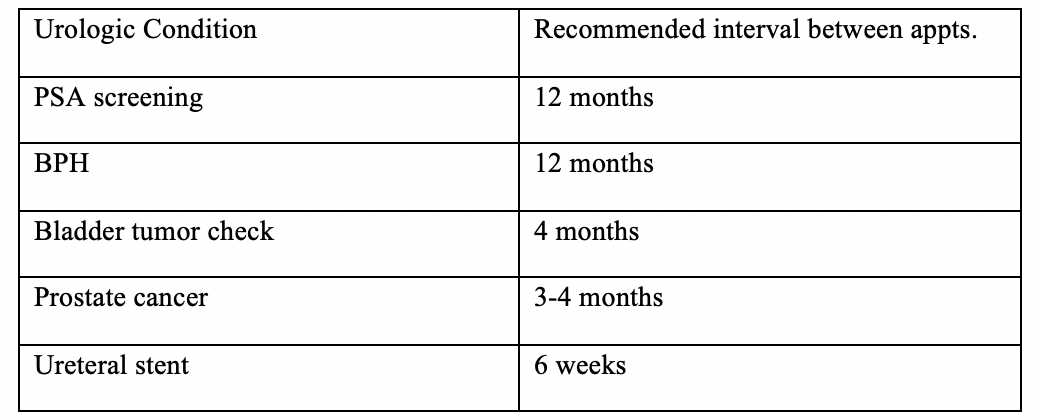
I suggest that you establish guidelines for the follow up intervals of specific patient populations. Figure 1 shows the example that was used in my practice.

Next, delegate someone as a recall-list coordinator. You might assign this position to PA, NP, medical assistant, or receptionist. Consider creating a recall list monthly.The recall list consists of three categories: 1) Patient already seen within the follow up guidelines, 2) Patient has an appointment already scheduled, and 3) Patient who needs an appointment for follow up.

Patients in categories 1 and 2 do not need be called as they are within the guidelines. Those in category 3 are called to schedule an appointment.

If you want to take this a step further, track the recall appointment rate by determining how many patients in category 3 made appointments.

Working on the recall list is a task that is frequently assigned to a staff member on days when I am in surgery or out of the office on vacation or attending a meeting.

Bottom Line: Recall lists are an effective tool to maximize fill your schedule and maximize your productivity by using your existing patient database. Remember, every time you call a patient it jogs their memories that you are still there and care about their urologic condition. Patients are impressed that you are paying attention to their follow-up needs and will feel reassured that they are in good hands under your care. Thus, a recall list is a win-win for the urologist-patient relationship.


Figure 1


15% Off Medical Practice Supplies


VIEW ALL


Manual Prescription Pad (Large - Yellow)


Manual Prescription Pad (Large - Pink)

Manual Prescription Pads (Bright Orange)

Manual Prescription Pads (Light Pink)

Manual Prescription Pads (Light Yellow)

Manual Prescription Pad (Large - Blue)

Manual Prescription Pad (Large - White)


VIEW ALL