
Table 1

Interestingly, we’re not seeing as large of a gender pay equity gap for physicians who work locum tenens - physicians who work temporary assignments to fill critical gaps in care. It turns out that locum tenens helps even the playing field when it comes to pay equity. Those who work locum tenens roles experience pay parity in many specialties; in other areas of care, pay gaps have narrowed at a faster rate when compared to those clinicians who work full-time positions in the healthcare sector.
A closer look at locum tenens specialties
My company recently conducted a gender pay gap analysis* to get a better idea of what’s happening in pay equity among physicians. Similar to the national research, male specialists in permanent roles made an average of $415,000, while their female counterparts made $327,000 — a 27% difference. However, when looking at locum tenens, the pay gap is significantly less—about 15 percent. In fact, women working locums actually out-earn their male counterparts in some specialties, taking home 11% more in general surgery and almost 6% more in medical oncology.

Table 2
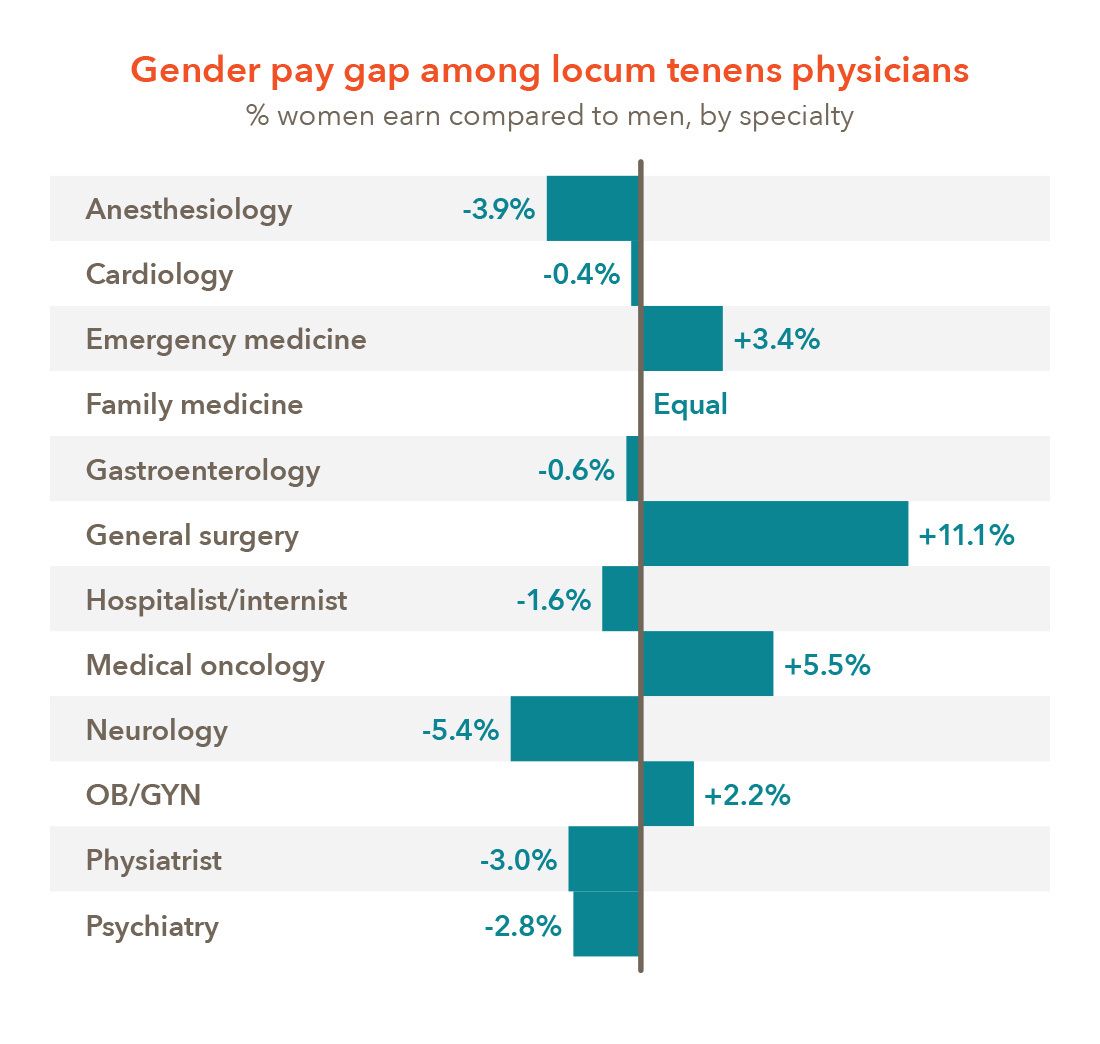
This raises an important question: What stands out about locum tenens versus permanent physician roles? Could locum tenens be laying a foundation for broader medicine to achieve pay equity across the sector for physicians? Let’s take a closer look.
Advantages of locum tenens for pay equityTransparent pay structures: Locum tenens positions often have more transparent pay structures. Pay rates are typically standardized across agencies, reducing the chances of gender-based pay disparities.
Flexible work arrangements: Locum tenens positions offer flexible work arrangements, which can lead to more consistent and equitable earnings. Many women — 38% — would have to cut back on hours or leave their jobs entirely without flexible scheduling, according to the latest Women in the Workplace report from McKinsey. Flexibility allows more female physicians to balance family and work, leading to higher total earnings spanning their career, and ensuring they remain eligible for promotions and raises they might otherwise miss if they took a break.
Negotiation opportunities: Because locum tenens physicians often work on short-term contracts, there are frequent opportunities to negotiate pay. This can lead to fairer compensation compared to long-term permanent roles where salaries might be less frequently adjusted.
Advocate in your corner: Walking into a negotiation is intimidating, and research indicates it can be even more so for women. It’s reassuring to have support. I like thinking of recruiters as sports agents — someone who has your back and best interests in mind. They can act as a sounding board for negotiation, and give your confidence a boost.
Take this quiz to see if locum tenens might be right for you by taking this quiz.
Locum tenens lays a substantial foundation for physician pay equity. Building upon it, there are other steps physicians can take to help reach pay equity and increase compensation such as working with a recruiter through a staffing agency. The hourly rate for locum tenens physicians can be much higher than traditional roles, especially for women. Furthermore, recruiters are often more knowledgeable about equitable salaries in individual markets and specific geographic locations.
Also, it’s essential for a physician to know their worth. Naturally, compensation for a physician coming right out of residency will be different from that of a physician 20 years into their career.
“Coming out of residency, any amount of compensation seems incredible,” says orthopedic surgeon, Nicholas Kusnezov, MD. “However, your time as a trained and skilled professional is worth a certain amount of money.”
New physicians may be presented with multiple offers that propose different compensation structures, Kusnezov adds. He recommends choosing the assignment that best reflects your training and desired pay. A stair-step approach is a great way to meet the goal, with no less than equal compensation for each successive assignment.
I always encourage asking trusted mentors and peers for their feedback, asking what a reasonable salary should be. Remember — you bring a unique set of skills and strengths to any position, and you should be fairly compensated for them.
Lastly, physicians shouldn’t be afraid to negotiate — regardless of the type of role, all compensation is up for negotiation. It is always worth asking, and the worst thing that could happen is you get a “no” for your answer. Don’t create your own barriers by not asking for what you are worth.
Achieving pay equity among physicians is a complex challenge, but the locum tenens model offers a promising path forward. By promoting transparent pay structures, providing flexible work arrangements, and creating frequent negotiation opportunities, locum tenens can help level the playing field. Examining the compensation model of locum tenens can provide valuable insights and set a precedent for achieving a more equitable playing field for permanent physicians across the healthcare sector. Pay equity should be the standard across all healthcare roles, benefiting not only the physicians but also the quality of care they provide.
15% Off Medical Practice Supplies
VIEW ALL


 Manual Prescription Pad (Large - Yellow)
 Manual Prescription Pad (Large - Pink)
 Manual Prescription Pads (Bright Orange)
 Manual Prescription Pads (Light Pink)
 Manual Prescription Pads (Light Yellow)
 Manual Prescription Pad (Large - Blue)

__________________________________________________





Appointment Reminder Cards
$44.05
15% Off
$56.30
15% Off
$44.05
15% Off
$44.05
15% Off
$56.30
15% Off
