Showing posts with label small business loans. Show all posts

Monday, December 12, 2022

Short-term vs. long-term small business funding for medical practices

Just like many other small businesses, it’s not uncommon for medical practices to rely on financing to expand or grow, cover costs during a low-cash-flow period, or upgrade your equipment or services. But what kind of funding is best for you? Between banks, SBA loans, and alternative funding, it can be difficult to choose the funding that best suits your practice’s needs.

One of the easiest ways to narrow down your options is to determine whether you need short- or long-term financing. In this post, we will explore short term vs. long-term loans for medical practices to help you determine which option is best for your specific situation.

Let’s take a closer look:


When is short-term or long-term financing ideal?


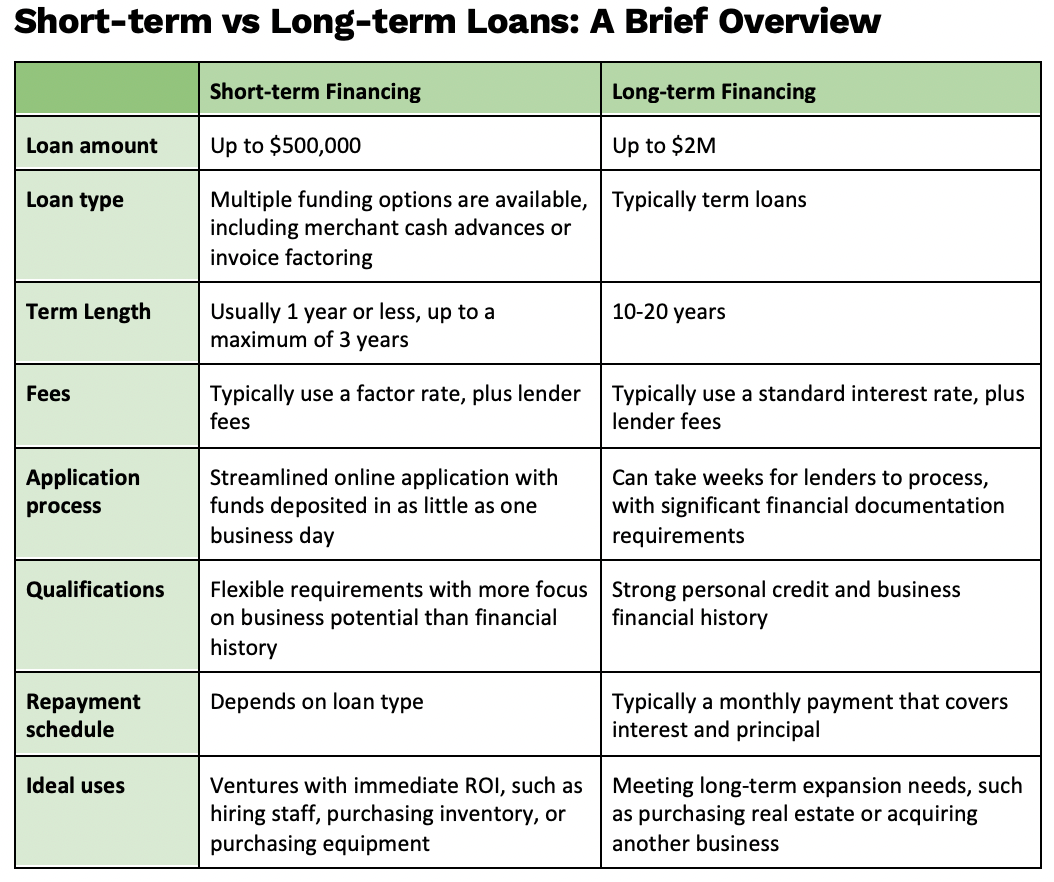
Short-term medical business loans are usually issued for smaller amounts and can typically be acquired more quickly and with less stringent documentation than long-term loans. Short-term small business funding is best used to finance opportunities that have a more immediate return on investment, such as hiring a new staff member or upgrading your practice management software. Short-term financing can also provide a quick infusion of working capital that can help you bridge the gap between insurance payments, invest in marketing your medical practice, or kickstart your growth.

Long-term medical business loans are typically offered for higher amounts and lower rates, making them ideal for large purchases or investments. The approval process takes longer and the requirements are stricter, so you’ll need to be able to demonstrate why you need the money, that it will be put to good use, and how you plan to pay it back. For this reason, long-term small business loans are best used for investing in longer-term ventures that may not have an immediate return on investment, but are necessary for growth, such as purchasing your officespace rather than renting it.
How medical practices can use short- and long-term funding

Medical practices can use both short- and long-term funding for different purposes. Each type of funding is suited to specific purchases or investments, so make sure you select the type of funding that is best suited to the purchase you want to make.
Short-term business loans

Short-term business loans are ideal for smaller expenses that you can act on and pay off quickly, such as:
  • Start up costs
  • Bridging cash flow gaps
  • Purchasing inventory or medical supplies in bulk for a discount
  • Covering costs of emergency repairs or other unexpected expenses
  • Hiring new employees
  • Purchasing equipment, tech, software
  • General working capital
  • Boosting your marketing
  • Improving patient services, such as upgrading your services to include online booking, online paperwork, updated wait times, quick responses to inquiries, free wifi in your waiting room, or extended hours

Long-term business loans


Long-term business loans are typically better suited to large expenses or purchases that you can pay down slowly, including:
  • Purchasing real estate
  • Acquiring another practice—this is a great way to expand your existing practice or avoid some of the pitfalls of starting your own from scratch.
  • Building or renovating facilities

Which type of term loan is right for my medical practice?


The type of funding that’s right for you, whether short-term or long-term funding, depends on multiple factors, such as how quickly you need the money, how much funding you require, what you plan to use your funding for, as well as details important to the lenders, such as your financial history and the financial health of your medical practice.


15% Off Medical Practice Supplies


VIEW ALL


Manual Prescription Pad (Large - Yellow)

Manual Prescription Pad (Large - Pink)
Manual Prescription Pads (Bright Orange)
Manual Prescription Pads (Light Pink)

Manual Prescription Pads (Light Yellow)
Manual Prescription Pad (Large - Blue)
Manual Prescription Pad (Large - White)


VIEW ALL

Wednesday, August 8, 2018

How to Get a Business Loan

Sooner or later most small businesses need to know how to get a business loan, whether to get the operating capital for business startup or to finance an expansion. But whether you're approaching a bank or a friend for a business loan t he lender will have the same expectations.

You can greatly increase your chances of successfully securing a loan by being prepared to meet those expectations.

Put yourself on the other side of the desk for a moment.


If someone asked you for a small business loan, you'd want to know exactly why he or she wanted the money and what the chances were that he or she would repay the loan in full and on time. So that's what you have to do.

How to Get a Business Loan? Prepare.


1) Check/establish your credit rating.


Understand that although you're going after a business loan, your personal financial standing will be scrutinized as well - especially your credit score and your debt to income, which should be no more than 33% of your gross monthly income.

You need to have a good credit rating if you are going to get a business loan from a traditional bank or through a government program. So it's a good idea to check out your credit report first to find out what your potential lender(s) will see when they look at it.

The credit report you receive will include information on what to do if you find errors in the report.


If you have a poor credit rating, you will want to take steps to repair your credit rating before trying to get a business loan.

In the U.S., you can get a free credit report once a year through the website AnnualCreditReport.com.

In Canada, you can get a free credit report by contacting one of the two credit reporting agencies, TransUnion or EquiFax Canada.


To receive your free credit report you will need to mail or fax one of these companies a request along with copies of two pieces of I.D. Note that you will not be able to get a free credit report through the website of either company; you will be charged a fee for an online report. CreditKarma provides free online credit reports through much of Canada.

(It's not necessary that you include a credit report with your small business loan application; it's easy enough for potential lenders to check your credit rating.)

If you are a person with no credit rating, you will need to establish one before you will be able to get a small business loan. Basically, you establish a credit rating by buying things on credit and paying back the money you owe. Your loan repayment history plays a big part in establishing your credit rating, but all your "credit" dealings make up the history that's used to determine your credit rating.

If you have an established business (in business for two years or more) you should also check out your business credit score and make sure there are no mistakes on your reports. 

2) Make sure your cash flow is flowing.


Investors want to see a healthy operating cash flow margin - and the healthier the better.


To them, your cash flow is the best indicator of your ability to pay back a loan. So if your cash flow is anemic or worse, choked off, you need to sort this out before you apply for a small business loan.
3) Gather together the documents that will help persuade the lender that a business loan is necessary and that you are a good risk.

Documents Needed

A business plan - The business plan shows the lender not only why you want a small business loan but what you plan to do with the money. Don't have one yet? Here's a simple business plan template you can use.

Cash flow projections - What's the first question any lender has? Will you be able to repay the loan? Your business's cash flow projections give lenders concrete financial data that they can use to assess this risk.

A statement of your personal financial status - A list of your personal assets and debts to give the lender a fuller financial picture.

You may also need these documents:

Past business tax returns - If your business is established and you have past business tax returns, it's a good idea to take them with you. They'll give the lender a better idea of how your business is doing financially.

4) Making the Presentation to the Lender


The next step in how to get a business loan is to persuade the lender that your business is viable and you are a good credit risk. You need to prepare in advance to make a winning loan presentation.

Start by considering the lender's point of view. You want money. But he or she is most interested in the answers to these two questions: "What are you going to do with the money?" and "Are you a good risk?", and to make a successful business loan presentation, you need to come up with the "right" answers to these two questions.

Answering the first question means being fully conversant with all the details of your business plan and being able to point to the relevant financial statements, charts or graphs that will help convince the lender that you need the amount of money you're asking for to do what you want to do.

Answering the second question means having already given some thought to the credit risk you represent to the lender and being ready to address their concerns.

To get a small business loan, be prepared to tell your potential lender:

What collateral you have - Collateral refers to the tangible assets that you are willing to put up to secure the loan. These assets might be equipment, a house, a car - something of value that you own. If you fail to repay the loan, then the proceeds from the sale of the assets are used for repayment.

How much money you're personally willing to put into the business - Being willing to risk your own money shows the lender that you're committed to the enterprise.

Your expertise and/or experience in your chosen field - Because the success of your business is dependent on this to some degree, any potential lender will want to know more about you. Be prepared to talk about yourself when you apply for a small business loan - your background, your expertise, and even your aspirations.

How to Get a Business Loan? Be Prepared


Your chances of getting a business loan will be greatly improved if you have all your documents in order and are prepared to assuage the lender's concerns about loaning you the money. Think of it as a presentation to an important client or customer, and you'll have a better chance of success.

15% Off All Business Cards

VIEW ALL